ChatGPT ads: 0.42% → 26.5% in three weeks (May 2026 update)

On this page
ChatGPT now carries paid ads in roughly a quarter of all responses. Today’s measurement of cloro’s monitoring corpus puts the rate at 26.5% overall and 49.1% within the US, up from 0.42% in our April-May study — a ~60× jump in three weeks. The rate is stable across the day, sitting in a 22–30% band hour over hour rather than spiking from a single noisy window.
The advertiser pool widened by roughly the same factor. Where our prior study saw a handful of B2B SaaS brands, today’s data shows hundreds of advertisers spanning consumer commerce, affiliate aggregators, mid-market SaaS, and major consumer-finance brands.
This post leads with what we see today. The Google-benchmark comparison from our April-May study sits at the bottom for context, but the headline has moved.
Table of contents
- Headline: 26.5% of responses
- What a ChatGPT ad looks like
- By country
- Advertiser mix
- What changed since the April-May study
- How this compares to Google’s AI ads
- The original April-May study (now superseded)
- Methodology
Headline: 26.5% of responses
| Metric | Original (Apr-May) | Today (2026-05-26) | Change |
|---|---|---|---|
| Overall ad penetration | 0.42% | 26.5% | ~60× |
| US ad penetration | ~0.5% | 49.1% | ~100× |
| Distinct advertiser pool | narrow (16-brand baseline) | order-of-magnitude wider | ~20× |
| Ads per ad-bearing response | 1 | 1 | unchanged |
The structural format is unchanged. Ads still render as a single Sponsored card under the response sources, one placement per response. What changed is volume and advertiser diversity.
Aggregating across every successful ChatGPT scrape today across all countries, the full-day rate sits at 26.475%, holding in a 22–30% band hour over hour — the headline isn’t a one-window flake.
What a ChatGPT ad looks like
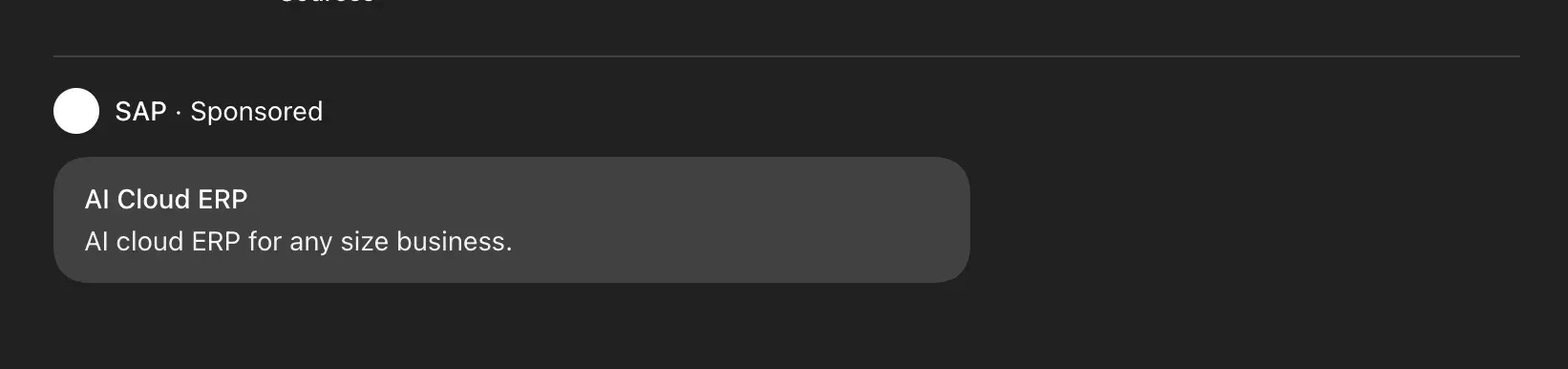
ChatGPT ads are returned in a response.result.ads[] array. Each entry has a brand object (name, URL, favicon) and a cards[] array with the creative (image, title, body, deep-linked URL), served from bzrcdn.openai.com and tagged with utm_source=chatgpt.com&utm_medium=src. So these are unambiguously paid placements, not organic recommendations.
Here’s one in the wild — an SAP “AI Cloud ERP” placement rendered inline beneath the response sources:
We exclude the other commercial surfaces in ChatGPT’s response payload — inlineProducts[] (multi-merchant product comparison rows) and shoppingCards[] (single-merchant product cards). Those are commercial but not unambiguously paid; including them would change the question. We covered them separately in our ChatGPT shopping post.
By country
Three English-speaking markets carry essentially all the ad load. Everywhere else is at or near zero.
ChatGPT advertising in May 2026 is an English-speaking-market product with the US carrying almost the entire share. The previous 94%-US figure from the original study now reads as understated.
Advertiser mix
Aggregating across multiple samples through the day, today’s largest US advertisers by cumulative placement volume: e.l.f. Cosmetics, Prismatic, Angi, Borderfree, BestMoney, Top10.com, Shopify, Pottery Barn, Monday.com, Jotform, IKEA, ULINE, Merchynt, YOOX, Home Depot, The Wall Street Journal, ADP, Datarails, Cars.com, Galactic Fed.
Six brands — Angi, BestMoney, Pottery Barn, Jotform, ADP, Cars.com — appeared in every sample we took today, suggesting steady all-day buyers. Most of the rest rotate intra-day: e.l.f. Cosmetics led one sample with the heaviest spend in that window but didn’t appear in another taken later. The implication is the active advertiser pool aggregated across a full day is materially wider than what shows up in any single snapshot.
Categorizing the top advertisers by industry gives a clearer picture of where the buying is concentrated:
The mix character has changed entirely. Our prior advertiser list was B2B-SaaS-heavy: Rippling, Semrush, HubSpot, CrowdStrike, Attio. The new mix is consumer-commerce dominant (e.l.f. Cosmetics, Pottery Barn, IKEA, Home Depot, Ralph Lauren, Macy’s), with heavy affiliate-aggregator presence (Top10.com, BestMoney, Insurify, Capterra) and a wider mid-market SaaS tail (Cursor, Jotform, Monday.com, Datarails, Tapistro, Smith.ai). Major consumer-finance and B2B brands (Expedia, Booking.com, Mastercard, ADP, Shopify) are still present but no longer dominant.
Industry shares above are computed across the top ~60 advertisers by placement frequency. The long tail (hundreds of smaller brands) likely shifts the bottom three categories upward marginally, but the headline — consumer commerce and B2B SaaS together account for roughly two-thirds of placement volume — is stable.
What changed since the April-May study
The April-May “equilibrium around 0.2-0.5%” reading wasn’t crazy on the data we had. ChatGPT and Google AI Overview were both running AI-native ads at similar rates; both rates were an order of magnitude below the mature Google SERP slot; the natural inference was that user-tolerance for ads inside a generative answer was the binding constraint, and both surfaces had converged on it.
The most plausible explanation, based on what’s publicly known about OpenAI’s rollout, is that ads in anonymous sessions are being ramped up. The Free-tier ad system shipped in February 2026 for logged-in users; the natural next step was expanding to non-account sessions, which is the surface cloro’s monitoring corpus sits on. If that’s right, what we’re seeing reflects coverage expansion — OpenAI lighting up an inventory pool that was previously dark to our measurement — rather than a step change in user-tolerance bounds.
What we don’t know yet: whether today’s rate is the new equilibrium, an overshoot as OpenAI tests demand response, or a midpoint to something higher. The next measurement will say more. The structural takeaway is that AI-native ad surfaces can sustain 25-50% penetration in lead markets, far beyond the ceiling the April-May data implied. The question worth tracking is no longer whether the surface stays sparse — it’s at what point user retention breaks.
How this compares to Google’s AI ads
The April-May read put ChatGPT (0.42%) between Google’s two ad surfaces: classic SERP sponsored slot at 1.05%, in-AI-Overview at 0.24%. Today, ChatGPT’s overall rate sits ~24× above Google’s classic SERP rate and ~100× above Google’s in-AI-Overview rate.
That’s not “ChatGPT caught up to Google.” That’s ChatGPT operating a fundamentally denser ad surface than either Google product on the same query cohort. Whether Google AI Overview follows the same expansion curve, or whether OpenAI’s higher rate reflects a willingness to push user-tolerance harder than Google will, is the more interesting question.
Microsoft Copilot, Perplexity, Google AI Mode, Gemini, and Grok still show ~0% paid ads. ChatGPT and Google AI Overview remain the only AI engines running paid in-response placements at all.
The original April-May study (now superseded)
The original headline: ChatGPT ads appeared in 0.42% of responses across our 19-day measurement window (2026-04-14 to 2026-05-02), with Google ads at 1.05% on AI-Overview-triggering SERPs and Google AI Overview ads at 0.24% on the comparable cohort. The framing was “ChatGPT looks close to equilibrium for an AI-native ad surface around 0.2-0.5%.”
That framing is superseded by today’s measurement. The full prior advertiser list (Rippling, Semrush, HubSpot, CrowdStrike, 11x AI, WSJ, Attio, Adobe Acrobat, Forbes, McAfee, Lenovo, Top10.com, Zapier, Pottery Barn, Shutterstock, Biom — 16 distinct brands across 19 days) is still useful context for how narrow the buyer pool was when the surface launched.
One observation from the April-May data still holds: AI labs are buying paid placements on Google’s AI Overview SERPs. chatgpt.com, perplexity.ai, and claude.ai all appeared in the Google sponsored-search slot on AI-Overview-triggering queries during that window. Whatever the public narrative about AI engines competing with Google Search, the labs are paying Google to drive traffic from those queries. That tells you something about where commercial intent still concentrates.
Methodology
The 2026-05-26 measurement is pulled from cloro’s monitoring corpus. Penetration rates (overall, US, hourly band) come from aggregating every successful ChatGPT scrape recorded today across all countries — a full-day sample, not a one-hour window. The advertiser list is aggregated across three samples taken at different points through the day, since the underlying log store retains full advertiser detail (metadata.raw_ads[0].brand.name) only for short windows; the three samples together give a fuller view of the active buyer pool than any single window does.
Detection signals: ads return in response.result.ads[], served from bzrcdn.openai.com, with destination URLs tagged utm_source=chatgpt.com&utm_medium=src. Any one of those three is sufficient to identify a paid placement; we check all three for redundancy.
Prompt-mix caveat: cloro’s corpus skews toward brand, comparison, recommendation, and B2B-software queries, with a heavy US weighting. Commercial-intent queries surface ads more often than general queries on any search surface, so the measured rates likely overstate what a uniform random sample of all ChatGPT prompts would show — particularly the US figure, since US commercial intent is the densest part of the corpus. The order-of-magnitude jump from the April-May rate holds either way; the specific point estimates are anchored to cloro’s prompt mix.
What’s still single-source: this is one independent measurement from one corpus. Adthena’s parallel analysis clocked penetration at roughly 0.8% on a different prompt mix during the original window; we don’t yet have a comparable second source for today’s rate. Treat the headline as a cloro-corpus signal until a second measurement lands.
If you want to track this for your own category — which brands buy ChatGPT placements on your priority queries, how often, in which countries — that’s what cloro’s ChatGPT Ads API is built for. For the broader AI visibility tracking surface across every AI engine, the AI brand visibility tracker and AI brand visibility measurement framework walk through how it works; the monitoring guide has the detection logic in code.
Frequently asked questions
Does ChatGPT have ads?+
Yes, and the rate has changed sharply. Our 2026-05-26 measurement found ads in 26.5% of ChatGPT responses (49.1% within the US), up from 0.42% in our original 19-day study (2026-04-14 to 2026-05-02). Ads are returned in `response.result.ads[]`, served from `bzrcdn.openai.com`, tagged with `utm_source=chatgpt.com`.
How often do ads show up in ChatGPT?+
As of 2026-05-26: about 1 in 4 responses overall, and roughly 1 in 2 within the US. Our original April-May measurement put it at 0.42% (~1 in 235). The jump in three weeks is roughly 60×.
Which countries see ChatGPT ads?+
In our 2026-05-26 measurement, the US (49.1%), Canada (33.6%), and Australia (19.8%) carry essentially all the ad load. UK is 1.5%. France, Germany, Japan, Spain, Netherlands, Italy, Mexico, Brazil, and the other 15+ countries we sampled all returned ~0%. ChatGPT advertising is, today, an English-speaking-market product with the US carrying almost the entire share.
Is ChatGPT showing more or fewer ads than Google?+
ChatGPT's 2026-05-26 rate of 26.5% overall (49% US) is far above both Google reference rates: roughly 24× Google's classic SERP sponsored slot (1.05% on AI-Overview-triggering queries) and 100× Google's in-AI-Overview ad rate (0.24%). The original framing — that AI-native ad surfaces converge around 0.2-0.5% — is wrong.
Who is advertising on ChatGPT?+
An order of magnitude more brands than in our prior April-May study (16 distinct advertisers then; many times that now). The new mix skews consumer commerce (e.l.f. Cosmetics, Pottery Barn, IKEA, Home Depot, Ralph Lauren, Macy's), affiliate aggregators (Top10.com, BestMoney, Insurify, Capterra), mid-market SaaS (Cursor, Jotform, Monday.com, Datarails, Tapistro), and major consumer/finance (Expedia, Booking.com, Mastercard, ADP, Shopify).
Can I track when my brand appears in a ChatGPT ad?+
Yes. cloro tracks paid placements across all seven major AI engines (ChatGPT, Google AI Overview, AI Mode, Perplexity, Copilot, Gemini, Grok) alongside organic mentions and citations. See the AI brand visibility tracker for how it works, or the technical monitoring guide for the detection logic.
Related reading
Does ChatGPT Have Ads? 2026 Rollout Status + What's Next
ChatGPT ads launched in February 2026 at $60 CPM with a $200K minimum, shifted to CPC bids of $3-5 within ten weeks. Penetration jumped from 0.42% (April-May) to 26.5% on May 26 (49% in the US). Here's the full rollout status.
How to Monitor ChatGPT Ads (Technical Guide, 2026)
ChatGPT ads render as a `response.result.ads[]` array on the response, served from `bzrcdn.openai.com` and tagged `utm_source=chatgpt.com&utm_medium=src`. Here's how to detect them with cloro's API and build a real monitoring pipeline.
Google Ads Transparency Center vs SERP Ads: which to use
These look like one search problem but they are not. The Ads Transparency Center is Google's public ad archive; SERP ads are the live sponsored results. Different products, different tools.